
Will AI Replace Mainframe Systems?

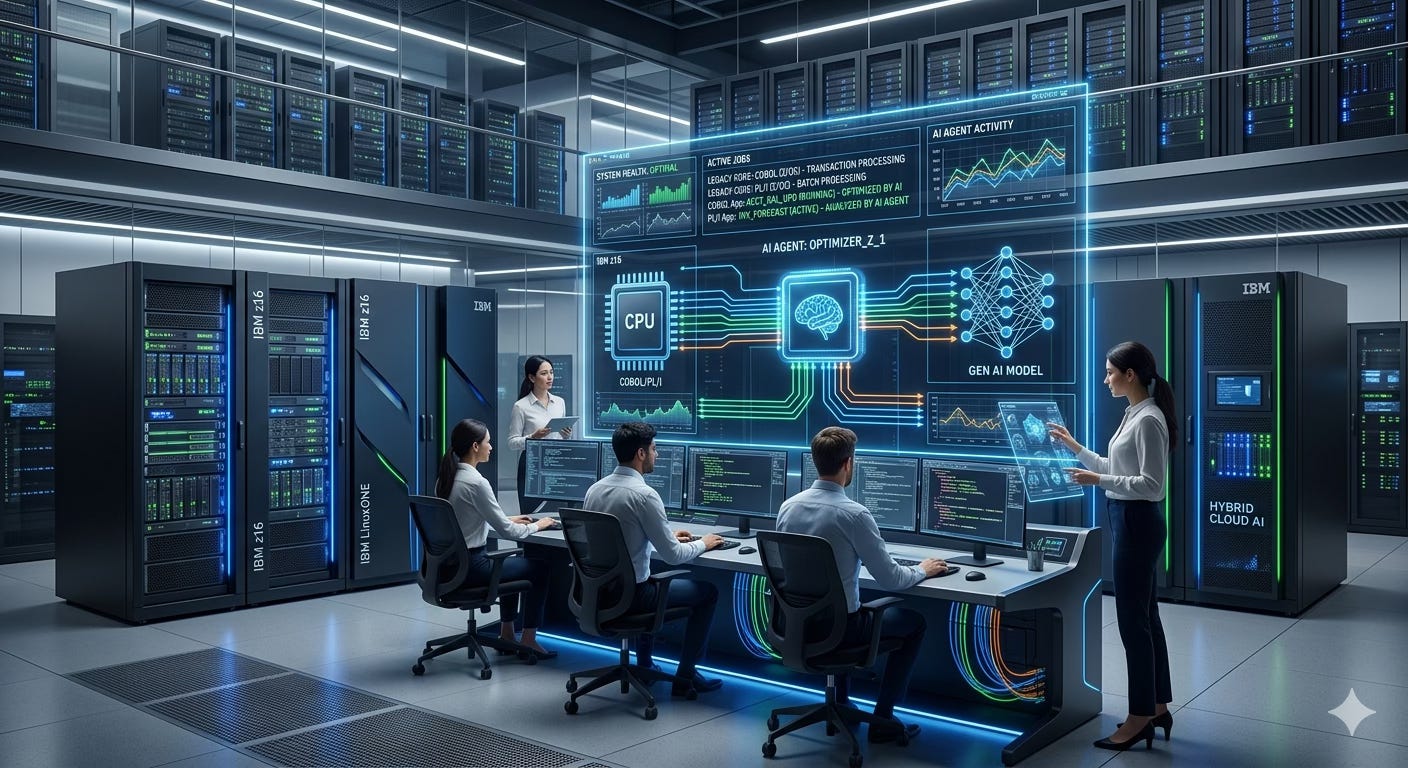
Across the business world, executives and technology leaders in the enterprise and large organizations want to retire their COBOL, PL/1 systems and legacy mainframe applications in favor of AI and intelligent agents, but that vision is still ahead of what’s currently possible.
More importantly, replacement may be the wrong starting point. The more productive frame is modernization, not rip-and-replace: COBOL still underpins the transaction processing backbone of global banking, insurance, and government, with systems that are stable, secure, and engineered to handle transaction volumes few modern architectures can match, so wholesale displacement carries substantial operational and financial risk. That risk premium has long been the mainframe’s most durable weapon when threatened. AI is now eroding it from multiple directions at once.
How AI Agency Is Posing an Existential Threat to Mainframes
Code comprehension and translation at scale. Generative AI tools—IBM WatsonX Code Assistant, GitHub Copilot for COBOL, AWS Mainframe Modernization, Google Gemini—can analyze millions of lines of COBOL or PL/I, map interdependencies, and translate components into modern languages, challenging the notion that migration is too complex.
Agentic coding loops, not just translation. Rather than one-shot conversion, agents analyze applications, generate human-validated specs, and execute against them; they also automate test creation—historically half the migration effort—reshaping the economics as testing time collapses.
Operational intelligence—the near-term wedge. The most immediate impact is not code replacement but interpretation: AI surfaces insights from SMF (System Management Facility) records, logs, and system telemetry via natural language, helping less-experienced engineers operate complex environments.
Agentic orchestration as the long-term mechanism. AI agents will coordinate across systems—not within them—turning fragmented processes into intelligent networks and enabling cloud-native workflows that erode the mainframe’s role as a monolithic system of record.
Mainframe Industry Leaders’ Response
IBM and BMC Software are both repositioning the mainframe as an AI-enabled, agent-driven platform, but with distinct emphases.
IBM is embedding AI across the SDLC and operations stack—introducing agentic development tools, AI assistants on z/OS, and multi-model orchestration via partnerships—while IBM Consulting shifts toward hybrid “human + AI agent” delivery at scale.
BMC focuses on AI-assisted DevOps and operations through its AMI portfolio, using generative AI to capture institutional knowledge, guide developers, and automate workflows via embedded assistants and anomaly detection.
In both cases, the strategy converges: use AI to reduce mainframe skill barriers, enable agentic automation, and position the mainframe as a governed execution layer for enterprise AI.
The Strategic Takeaway
Mainframe displacement is emerging in three waves:
AI as interpreter—providing operational insight and knowledge transfer;
AI as translator—driving agentic migration of discrete applications; and
AI as orchestrator—coordinating workflows that replicate mainframe capabilities in cloud-native environments with stronger economics.
Most organizations will traverse this journey through hybrid models that blend AI-driven analysis with traditional engineering controls, keeping the transition gradual rather than binary and sustaining demand for advisory, orchestration, and assurance services even as migration labor becomes increasingly automated.