
What Anthropic’s Export-Control Shutdown Reveals About AI Governance
The U.S. government took two frontier models offline overnight. The precedent matters more than the models.

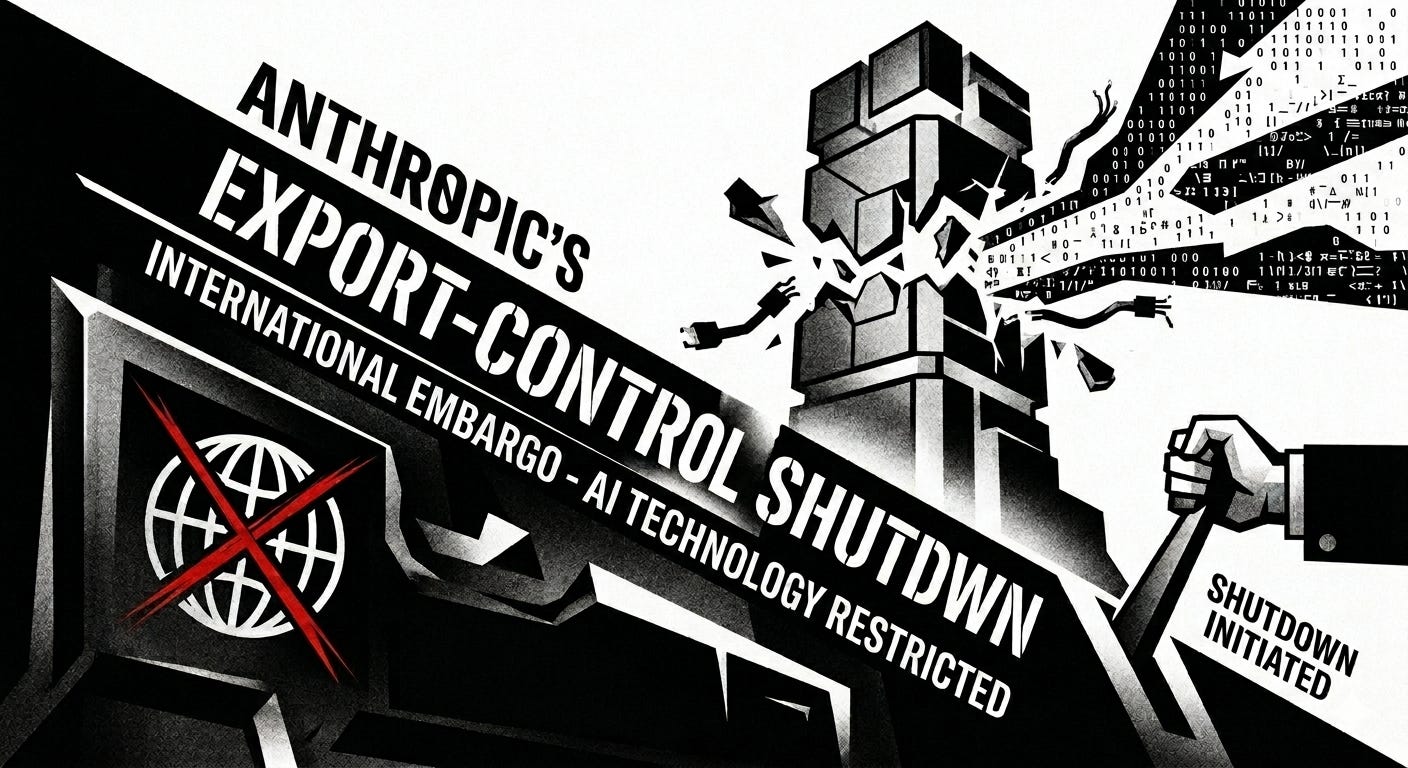
This past Friday evening, Anthropic said it received a letter from the U.S. government imposing export controls on its two newest models, Claude Mythos 5 and Claude Fable 5, citing national security concerns.
The catch is in how the export-control directive was written: it blocked the models for any foreign national — not just people overseas, but foreign citizens inside the U.S., including Anthropic’s own employees. With no reliable way to verify nationality in real time, Anthropic couldn’t block only some users; to comply, it shut both models off for everyone. Other models, like Claude Opus 4.8, stayed fully functional.
Anthropic says the letter never spelled out the actual concern, believes it’s a misunderstanding, and is working to restore access.
The real issue is precedent
This episode shows the government has both the power and the willingness to pull a frontier model offline worldwide, essentially overnight — and you can’t argue against a charge you can’t see.
A blunt instrument
The stated rationale was a single workaround that got the model to flag software vulnerabilities. The response barred every foreign national — visa-holders, residents, and Anthropic’s own staff included — enormous collateral damage relative to the problem, sweeping in people with no connection to any threat.
It may even be self-defeating
Anthropic argues the same capability exists in other public models and is used routinely by cybersecurity defenders. If true, disabling one company’s model doesn’t close the gap — it just penalizes the provider that got singled out, while the capability remains available elsewhere.
The chilling effect
If any frontier model can be pulled on unspecified grounds, that injects deep uncertainty into the whole industry. Investors and builders must price in the chance a launch gets yanked, and by Anthropic’s own logic, applying this standard broadly would freeze new releases generally — slowing legitimate development or pushing it elsewhere, against the very competitiveness goals such controls are meant to serve.
Security or leverage?
Reporting notes an existing feud and lawsuit between Anthropic and the administration. When a discretionary, unexplained power lands on a company the government is already fighting with, it’s reasonable to worry the tool could be used punitively — and that the precedent normalizes that leverage.
To be fair
If a frontier model genuinely unlocked a dangerous, novel cybersecurity threat well beyond what’s public, a government moving fast to prevent proliferation before explaining itself could be defensible. National security sometimes requires acting ahead of disclosure. The dispute is ultimately factual — whether the capability was novel and dangerous or routine and widely available — and much of why this looks bad rests on Anthropic’s account, which is, so far, contested.
The precedent point is the right one to sit on, and I'd push it further. Anthropic didn't just get caught by this mechanism. It argued for years that government should have exactly this sort of pre-deployment authority: FAA-style review, the power to block or deter a deployment. What it assumed came bundled was the transparency. Published thresholds, a process you can contest. So the boomerang isn't that a safety advocate got regulated. It's that you can't ask for a discretionary brake and then object only to whose hand ends up on it. The charge you can't see isn't this administration's bad manners. It's a property of the architecture they requested.