
The Drawer Is Gone
On privacy, AI, and what we may actually be mourning

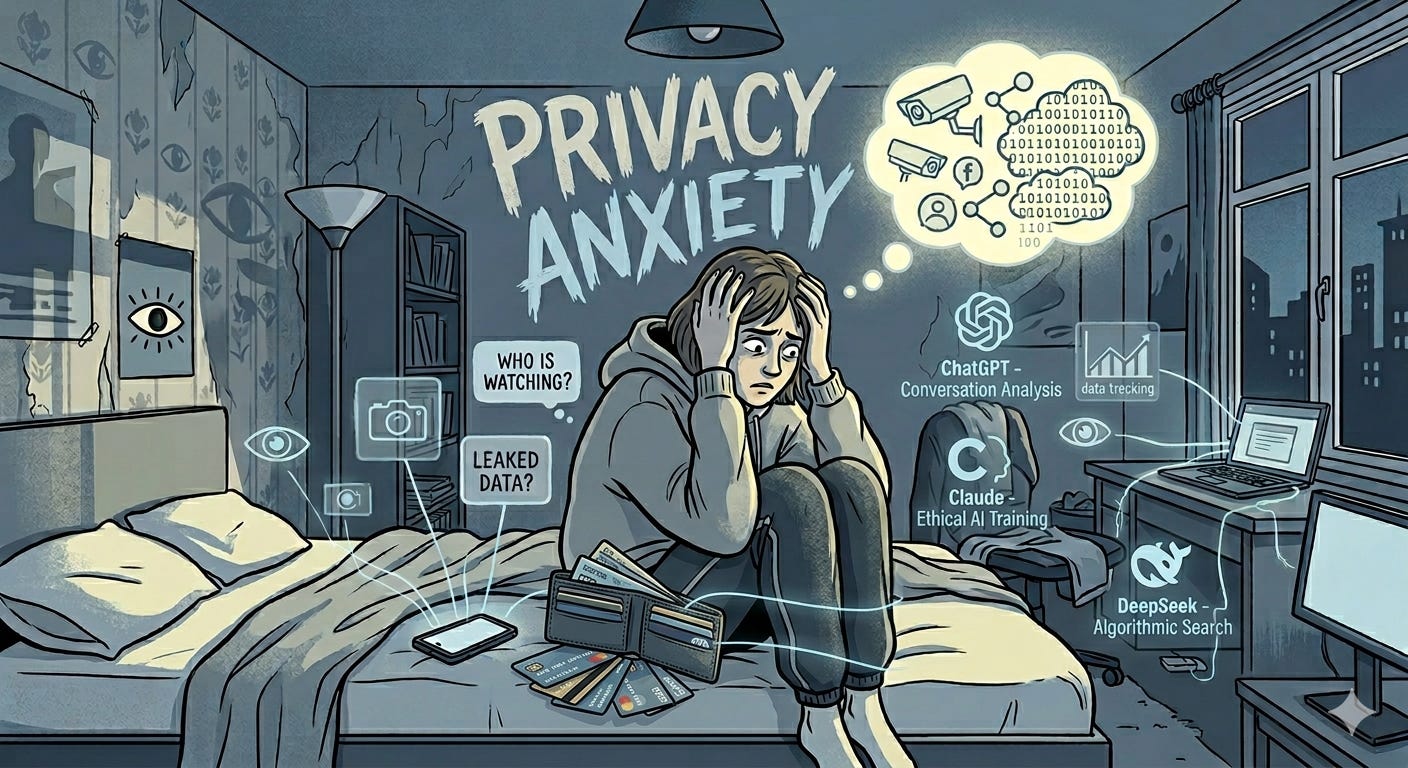
There was a time, not so long ago, when “privacy” meant closing the bathroom door and getting some privacy, or hiding your diary in the bureau drawer.
Now it means something closer to a low-grade hum of dread that follows us from the moment we unlock our phones until we set them down at night, glowing accusingly on the nightstand.
It started with Google and Amazon. In June of 2007, with the iPhone, we figured out that the free mobile search, shopping, email, maps and even Google Scholar came with a hidden price: our personal data. We were the product. Our searches were read, our movements logged, the shoe we glanced at Tuesday followed us until Friday. We shrugged. Targeted advertising, we told ourselves, was the reasonable price of admission to modern life — and besides, what did we have to hide?
Then came the breaches. Target. Equifax. Anthem. Yahoo. The OPM hack that handed the personnel records of millions of federal employees to a foreign government. Suddenly the abstract worry about “data” became the concrete worry about your data — your Social Security number, your mother’s maiden name, the answers to those security questions you set up in 2003 and can no longer remember. The dark web became a phrase people said at dinner parties. Credit monitoring went from a niche service to a standard apology gift, handed out like mints after a meal you didn’t order.
We adjusted to that, too. We froze our credit. We turned on two-factor authentication, mostly. We accepted that our information was out there somewhere, drifting through servers in countries we couldn’t find on a map, and we made our peace with the fact that this was simply the texture of being alive in the twenty-first century.
And then came the AI age, which has done something genuinely new to the anxiety.
The old worry was that someone — a company, a hacker, a government — had your information. The new worry is harder to name. It’s that everything you’ve ever typed, said, written, or photographed is now potential training data. That the voice memo you sent your sister could be cloned. That the photos of your kids could be scraped, generated, recombined. That the chatbot you confided in over a long, lonely Tuesday remembers more than you’d like, and may or may not be discreet about it.
The unsettling part isn’t just the scale. It’s the ambient quality of it. You can’t quite point to what’s been taken, because nothing has been taken in the old sense. You’ve simply contributed, mostly without meaning to, to a vast statistical impression of yourself that now exists somewhere outside your control.
The diary in the drawer is gone. The drawer is gone. The room is gone.
I don’t think we’ve metabolized this yet. Our privacy instincts were built for curtains and filing cabinets. The threats have moved somewhere our intuitions can’t follow. Maybe new instincts will develop. Maybe the next generation will find all this perfectly normal, the way mine finds targeted ads normal.
Or maybe privacy, as we understood it, was a brief historical accident — a feature of the twentieth century, bookended by the village gossip on one side and a machine learning algorithm on the other.
In which case the anxiety isn’t a problem to be solved.
It’s grief.