
The Agentic Enterprise Is Coming. Most Companies Aren’t Ready.

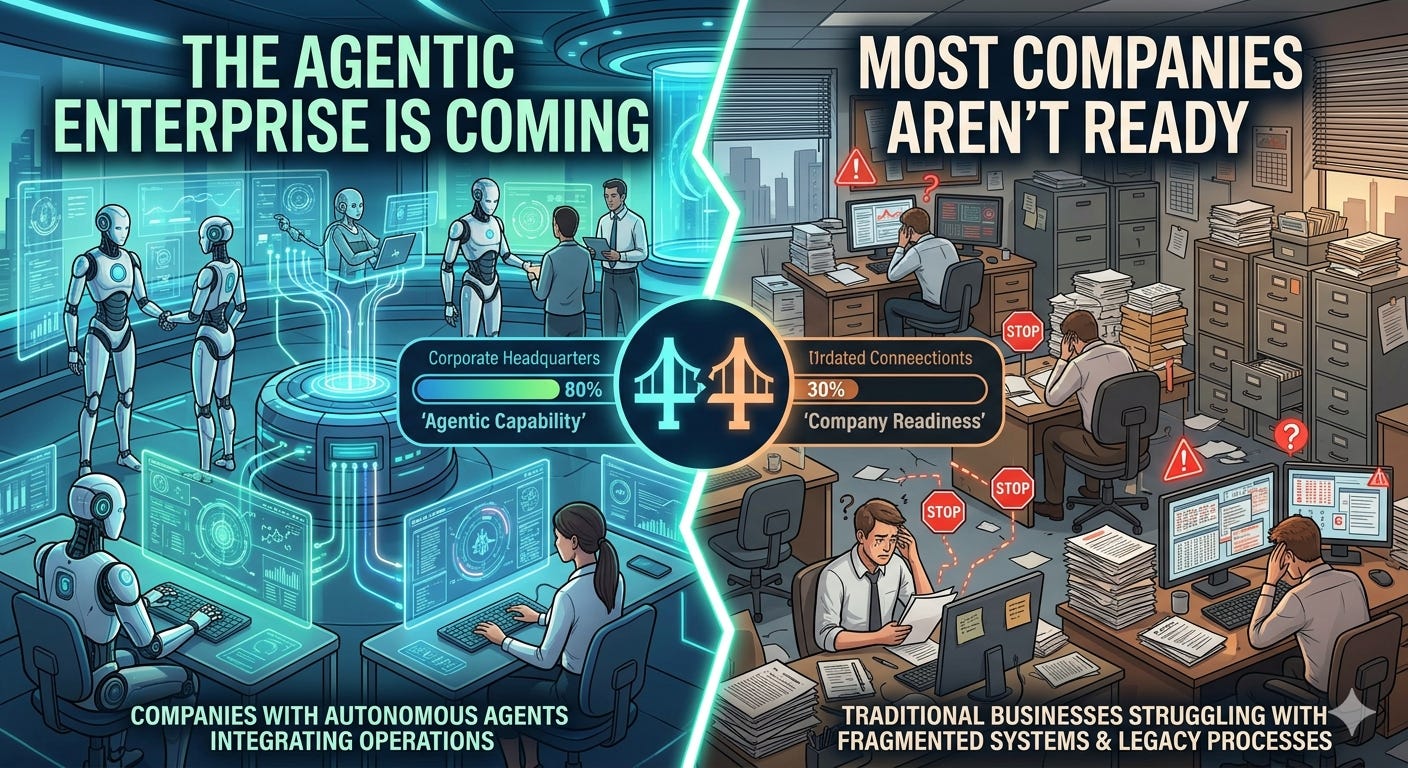
Recent data is striking even accounting for the usual inflation by research analysts:
Gartner-style forecasts project that roughly one-third of enterprise software applications will include agentic AI by 2028 — up from less than 1% in 2024.
Separate industry syntheses put the near-term figure even higher: 40% of enterprise applications integrating task-specific AI agents by end of 2026.
Whether the precise numbers hold or not, the directional signal is unambiguous. Agents aren’t a experiments anymore; they’re becoming the architecture.
What makes this shift meaningful isn’t the percentage of apps touched. It’s what agents actually do inside them.
By 2028, at least 15% of routine work decisions (routing, approvals, next-best-action recommendations) are projected to be made autonomously.
That’s the more consequential metric. Software embedded with AI agents isn’t just faster. It’s making calls.
Where agents are already working
Production-grade deployment today clusters around a handful of functions: customer service, software engineering, IT operations, sales and marketing, and supply chain. Banking, insurance, retail, healthcare, and higher education lead in active deployment with agents handling multi-step processes end-to-end rather than simply fielding queries.
Customer service is the most mature domain. Projections there are aggressive: agents resolving as much as 80% of common service issues by the late 2020s, with operational cost reductions of roughly 30% at full implementation. Enterprise case studies report meaningful gains — faster financial closes, smoother HR onboarding, reduced IT downtime — when agents orchestrate across systems rather than sitting inside a single one. That orchestration piece matters. Agents that hand off across platforms are categorically more useful than glorified chatbots.
The scaling gap no one wants to talk about
Here’s where the narrative gets complicated. Despite years of experimentation, fewer than 10% of organizations have scaled AI agents in any single function to a mature, production-wide level. About of firms 6% qualify as AI “high performers,” with more than 5% of EBIT attributable to AI. Moreover, they’re estimated to be three times more advanced in agent deployment than the median enterprise.
The gap between experimentation and scale is real, and it’s not primarily a technology problem. Integration complexity, unclear value realization, and governance shortcomings are the recurring culprits. One forward-looking analysis warns that more than 40% of agentic AI projects could be canceled by around 2027 for exactly these reasons. That’s not a prediction of failure for the technology; it’s a prediction of failure for implementation strategies that treat agents as plug-and-play rather than as organizational change.
Regional patterns add nuance. North America is highly experimental but under-scaled. Europe and Asia are more cautious but more methodical about production deployment. Some emerging markets are leaning into agents as part of broader digital modernization, skipping legacy infrastructure phases entirely.
The agentic enterprise is not a hypothetical. It’s being built right now, unevenly and imperfectly, mostly by a minority of firms that figured out early that scaling AI is an operational problem as much as a technical one. The rest are still running pilots.