
Social Media has Evolved into Something Beyond Social Networking

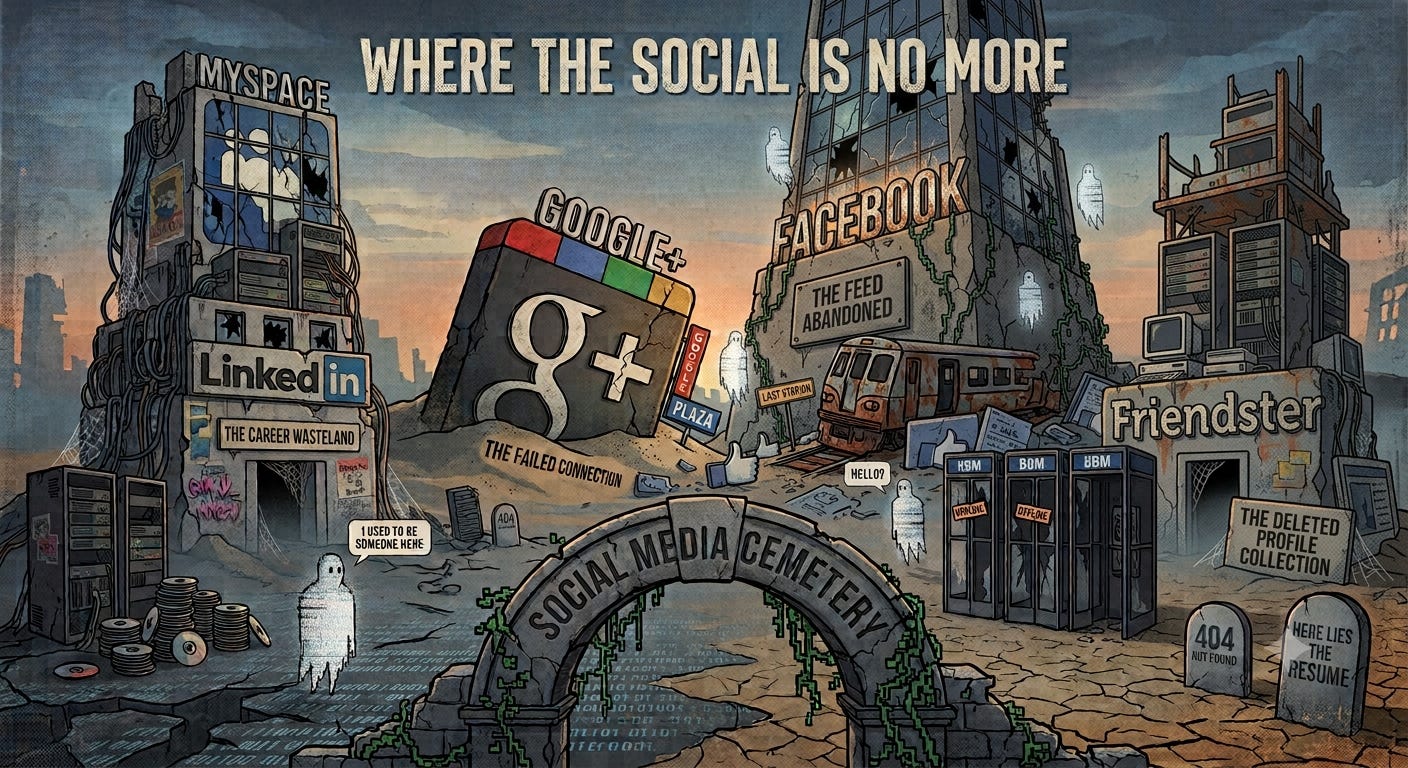
Danah Boyd, a communications researcher at Cornell, has published an important yet overlooked essay, "Social Media Is Now Parasocial Media," arguing that "social media" no longer describes the platforms it once named.
In other words, social media platforms are no longer social media.
When the term emerged in the mid-2000s, it described tools that let people socialize with friends and communities through posting and connection. But two decades later, users mostly scroll rather than post, and feeds are dominated by ads and algorithmically curated content from influencers and commercial entities rather than personal updates from friends.
This shift wasn’t inevitable; it resulted from platforms centralizing around a few corporations that, chasing financialized growth, found scrolling more profitable than sociality and rewarded polished, algorithm-gaming content over genuine connection.
Boyd proposes replacing “social media” with “parasocial media” to reflect this reality: users now form one-sided, non-reciprocal relationships with creators and celebrities they track from a distance, rather than reciprocal social bonds.
I agree wholeheartedly with Boyd on this proposal.
This isn’t mere nostalgia for early Internet culture. Boyd argues the terminology shift matters because it should reorient how researchers, policymakers, and the public think about governance, inequality, and sociality on these platforms, since the practices that originally justified the “social” label are no longer what’s dominant or being analyzed.
From my standpoint, the shift is even more profound—and more concerning.
The future isn’t social media; it’s AI-curated media.
Human connections are no longer the primary organizing principle. Instead, increasingly sophisticated algorithms decide what we see, what captures our attention, what shapes our opinions, and ultimately how we engage with the world.
The social graph is giving way to the AI graph, where recommendations, predictions, and optimization matter more than the relationships that originally defined these platforms. What began as a way to connect people is rapidly becoming an ecosystem where artificial intelligence curates, prioritizes, and increasingly mediates nearly every online experience.
Conclusion
If Boyd is right that we’ve entered the era of parasocial media, then we’re already standing at the threshold of its next evolution. The defining feature of the next generation of platforms won’t be the creators we follow—it will be the AI systems that decide what deserves our attention in the first place.
That shift has profound implications. Whoever controls the algorithms increasingly controls discovery, influence, public discourse, and, ultimately, perception itself. The central question is no longer who you’re connected to; it’s who—or what—is curating your reality.
We should stop pretending Facebook, LinkedIn, IG and others are social platforms. They have become AI-powered attention systems that shape behavior at planetary scale. Recognizing that change isn’t just a matter of semantics. It’s the first step toward understanding the economic, political, and societal consequences of a world where artificial intelligence increasingly mediates what billions of people see, believe, and do.