
OpenAI’s Spotify Playbook
OpenAI is chasing Spotify’s scale-without losing its speed

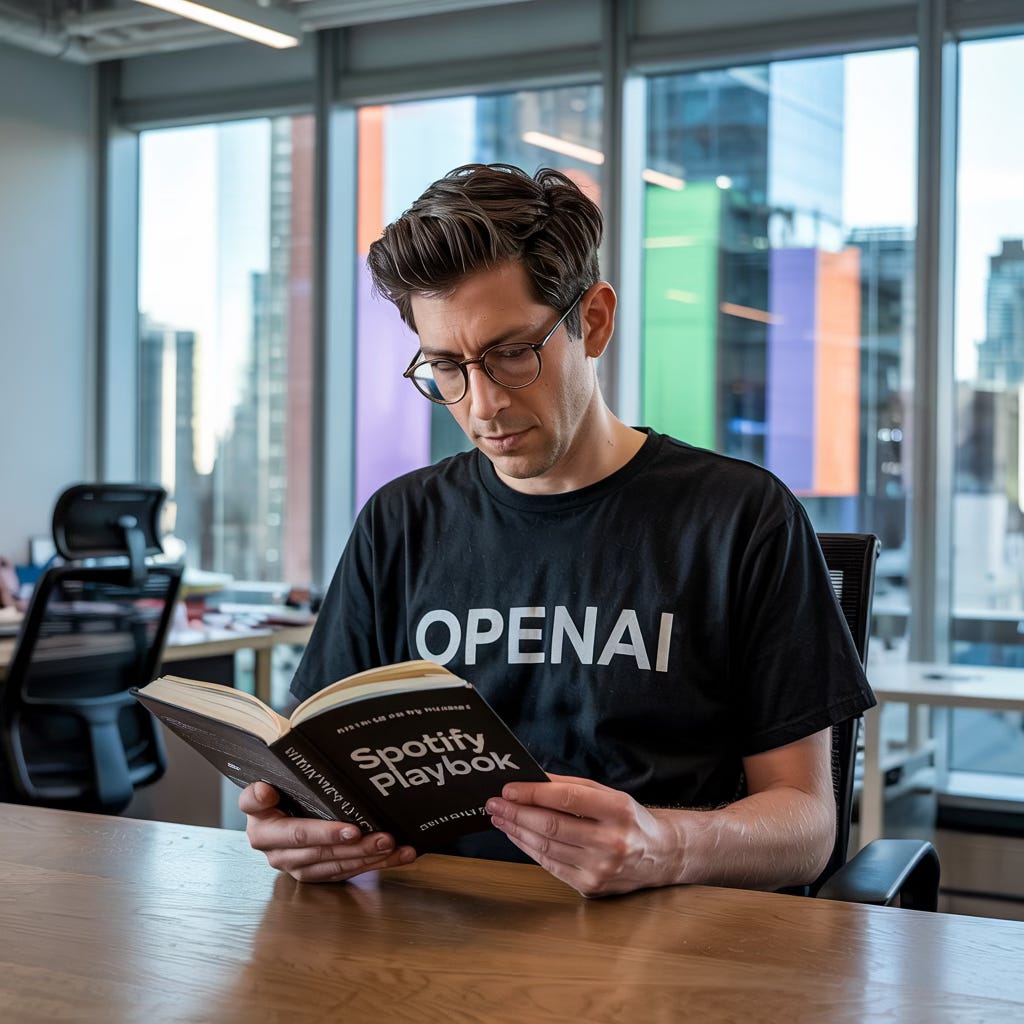
The moment “Your Year with ChatGPT” popped up in my Atlas browser — OpenAI’s take on Spotify Wrapped — I clicked in, and it immediately prompted a comparison: Spotify and OpenAI.
We know that Spotify is the heavyweight champion of a mature subscription category: music streaming, and that OpenAI is the breakout leader in an exploding new category: consumer + enterprise GenAI. Put them side by side and you get a clean contrast: scale (Spotify) vs. speed (OpenAI).
A short comparable analysis:
Market “Share” (imperfect but telling). Spotify dominates a mature subscription market (~32% of paid music streaming), while OpenAI commands ~80% of GenAI web traffic — less about revenue share, more about attention. In short: Spotify leads in paid share; OpenAI leads in GenAI market share and AI mindshare.
Revenues: Spotify is larger today; OpenAI may be compounding faster. Spotify’s most recent full-year figure (2024) is clear: €15.6B in annual revenue (public filings/earnings coverage). OpenAI’s revenue is reported by reputable business press (private and not audited the same way): ~$4B in 2024 and ~$13B in 2025 (reported in multiple outlets).
Cost Comparison: rights vs. compute. Spotify’s economics are dominated by licensing and creator payouts; OpenAI’s by compute. In both cases, the primary cost driver sits outside the company’s direct control: Spotify doesn’t own music rights, and OpenAI doesn’t fully control its compute cost curve. Spotify’s revenue is larger and audited; OpenAI’s is smaller (for now) but scaling quickly-where unit economics will be decided by compute efficiency, pricing power, and enterprise retention.
Valuation: public consensus vs. private expectations. Spotify’s ~$119B market cap (Dec 2025) reflects current performance; OpenAI’s reported ~$500B-$750B private valuation prices in platform-scale potential. The market’s message: AI isn’t a feature cycle — it’s a platform shift.
Business Models: content-constrained vs. compute-constrained. Spotify is a two-sided marketplace (listeners & creators/labels) that monetizes access (subscriptions + ads) and optimizes acquisition‚ retention, ARPU (ave. rev. p/user) — but margin upside is structurally capped by rights economics and payout obligations (including its “$10B in 2024” creator/industry messaging). OpenAI is a product + platform business (consumer, enterprise, APIs) that monetizes capability-where margin leverage comes from lower compute per unit of value, stronger pricing, and durable enterprise stickiness.
Constraints: Spotify’s constraint is rights; OpenAI’s is compute. Both try to widen margins by moving up the stack — Spotify into podcasts/audiobooks/tools; OpenAI into enterprise workflows, distribution, and ecosystem gravity.
Competitive Posture: Stable war vs. chaotic war. Spotify competes in a category with stable rules — persistent, incremental battles. OpenAI competes in a category with changing rules-constant leapfrogging across models, modalities, and distribution. Spotify’s moat is brand + personalization + habit; OpenAI’s is quality + distribution + developer ecosystem + trust.
The Takeaway: one is fully optimized; the other is still evolving and positioning for an eventual public-market debut. Spotify shows what dominance looks like in a mature subscription category. OpenAI shows what dominance looks like in an emerging platform shift: massive attention share, rapid revenue growth, and valuations that price in an industry rewrite. If Spotify is a great business constrained by content economics, OpenAI is a potentially great business constrained by compute economics. The next few years will be defined by who can flex their constraints most quickly.
Scale vs. speed. And the market is betting that speed wins … if it hardens into no-brainer platform certainty.