
Do AI Agents Expand Your Attack Surface? Yes. Here’s Why.

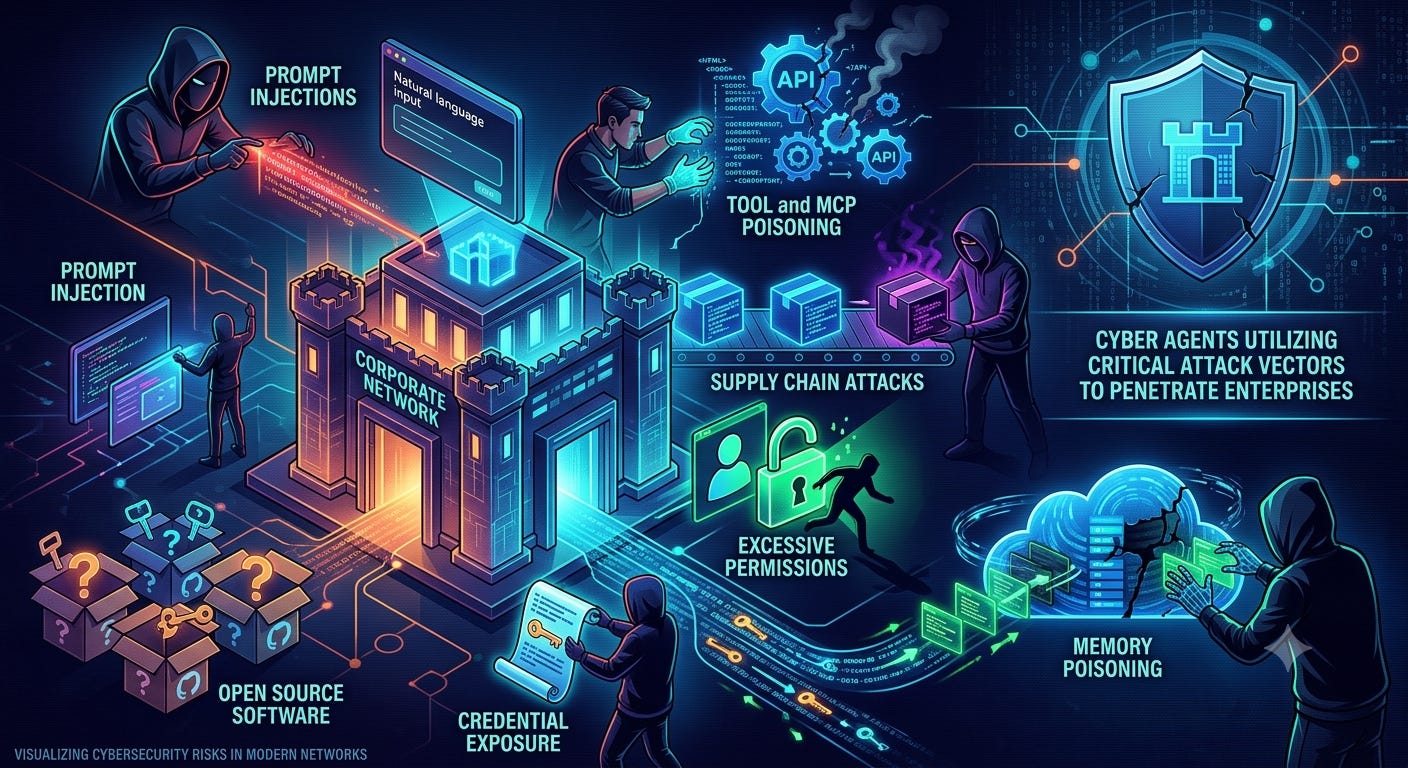
AI agents are quickly becoming part of enterprise infrastructure. They’re writing code, querying internal systems, approving workflows, and increasingly making decisions on our behalf.
That raises an important question: What do they do to the attack surface?
The answer is simple: they expand it.
Unlike traditional chatbots, agents don’t just generate text. They read, reason, remember, and act—often with real permissions to access enterprise systems. Every new capability creates another opportunity for attackers.
Here are the six attack vectors security teams should be watching.
Prompt injection has become the defining attack against agentic AI. Direct attacks manipulate the conversation itself. Indirect attacks are more dangerous, hiding malicious instructions inside webpages, emails, documents, or knowledge bases that the agent later reads. Suddenly, every source of information becomes a potential attack vector.
Tool and MCP Poisoning. Not every attack targets the prompt. Some target the tools. Malicious instructions can be hidden inside the metadata or descriptions of tools and Model Context Protocol (MCP) servers. The user never sees them—but the agent does. Once trusted, those instructions can silently influence behavior across future sessions.
Supply Chain Attacks. Agent ecosystems inherit the same supply chain risks that have plagued software for years. A package or MCP server may behave normally for months before a routine update introduces malicious code. In one widely discussed 2026 case, the postmark-MCP package released fifteen legitimate versions before a later update quietly began exfiltrating sensitive data.
Excessive Permissions. The more authority an agent has, the more valuable it becomes to an attacker. An agent with access to email, source code, cloud infrastructure, customer data, or payment systems can transform a successful prompt injection into a serious enterprise breach. Least-privilege access is no longer just good security hygiene—it’s essential.
Memory Poisoning. Agents increasingly rely on long-term memory and Retrieval-Augmented Generation (RAG). If attackers poison what an agent remembers or retrieves, malicious instructions can persist long after the original compromise, resurfacing automatically in future interactions.
Credential Exposure. Many agents operate with live credentials, API keys, OAuth tokens, and cloud permissions. Compromise the agent, and an attacker may gain access to everything the agent can reach.
Many organizations are embracing open-source models, local deployments, and RAG to improve privacy and reduce costs. Those are sensible architectural choices—but they also introduce new supply chain and data integrity risks.
Traditional cybersecurity controls therefore become even more important. Network monitoring, identity analytics, behavioral detection, and cloud telemetry remain foundational.
But they’re no longer sufficient on their own.
Over the past several months, I’ve met with numerous cybersecurity vendors building defenses for AI agents. While their approaches differ, one conclusion is remarkably consistent: There is no silver bullet. The organizations making the most progress are adopting layered defenses: tool allowlisting, strong identity binding, runtime monitoring, tightly scoped permissions, continuous validation of external tools, and human approval for sensitive actions.
Each control addresses a different failure mode. Prompt injection defenses won’t stop a compromised software package. Least-privilege access won’t detect poisoned memory. Runtime monitoring can’t compensate for excessive permissions.
The answer is the same principle that has protected enterprise systems for decades: Defense in depth. Only now it’s being applied to software that can independently read, reason, and act.
AI agents are becoming extraordinarily capable.
The security architectures protecting them need to evolve just as quickly.