
China Is Turning AI into Infrastructure. The U.S. Must Rethink the Game.

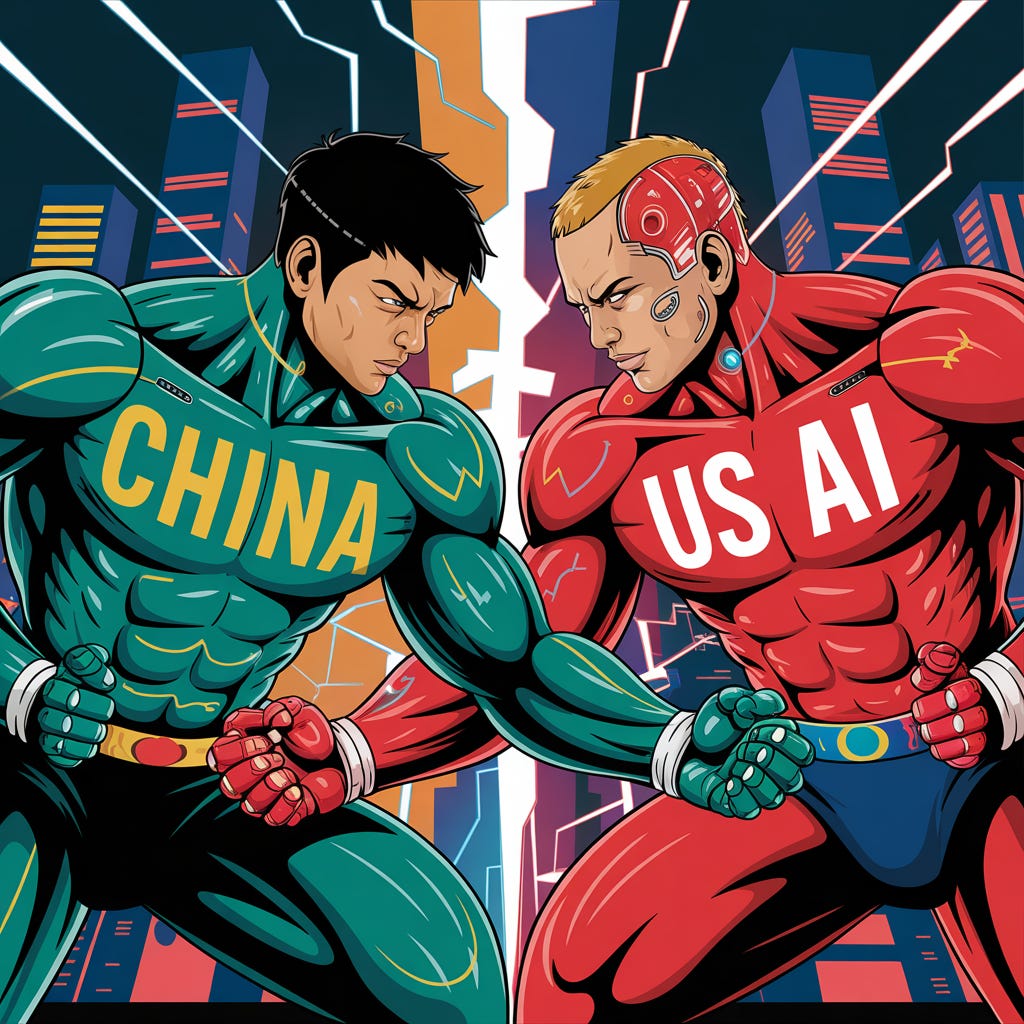
Scott Galloway argues that China’s AI strategy prioritizes efficiency, cost reduction, and commoditization—favoring GPU-light architectures and faster, leaner models that do more with less. While the U.S. focuses on premium, large-scale, brand-driven AI, China is building on open source to create cheap, massively scalable LLMs. The goal, he suggests, is to trigger a price war that could crush the U.S. AI industry via model margins, erode U.S. tech company valuations, and ultimately destabilize the broader U.S. economy—given its heavy reliance on the Magnificent 7 or 10. (China Decode on YouTube here)
This scenario is possible, but from my point of view, China’s AI strategy is a state-driven industrial policy spanning the entire tech stack—semiconductors, cloud, data, talent, and applications—embedding AI across key sectors like finance, manufacturing, healthcare, and urban systems under the “AI+” model. Innovation is tightly regulated to align with national interests and “core socialist values.” Globally, China aims to shape AI standards, export AI infrastructure, and expand its technological influence.
This state-backed, full-stack strategy is now beginning to show tangible results in global AI adoption. Supporting this view, Clem Delangue, CEO of Hugging Face, noted that the platform is seeing more downloads of Chinese AI models than American AI ones—many of which are trained and optimized on Chinese hardware such as Huawei rather than Nvidia.
Ultimately, the finer distinctions between these perspectives matter less than the broader reality: in the head-to-head race between the two AI superpowers, the United States is beginning to lose momentum. What’s at stake is not simply differing approaches, but the erosion of technological leadership, influence over standards, and control of the infrastructure that will define the next era of global power.
Here’s a polished, publication-ready section for your Substack post, consolidating the earlier recommendations. It preserves strategic depth but tightens and elevates for narrative flow, readability, and thought leadership positioning.
What the U.S. Must Learn from China on a Structural Level
China is not just building cheaper AI models—it is building AI-shaped national infrastructure. Across semiconductors, cloud, data, sector-specific applications, talent pipelines, regulation, and export strategy, AI is embedded as a nationwide industrial policy. They are building the stack, not just the models—and exporting it globally as part of their geopolitical footprint.
And it’s beginning to show. Hugging Face CEO Clem Delangue recently noted that Chinese AI models are being downloaded more frequently than American ones—optimized not for Nvidia, but for Huawei. The shift isn’t about model performance alone, but about ecosystem control, infrastructure independence, and strategic reach.
The implication is clear: the U.S. cannot win this race on model scale, premium branding, or GPU intensity alone. It needs to compete on strategy.
From Models to Systems: Six Strategic Shifts
From Bigger to Leaner. Shift from massive general models to GPU-efficient, specialized, data-centric systems built for sectors like energy, healthcare, defense, and finance.
From Tech-First to Industrial Strategy. China aligns chips, cloud, applications, and regulation. The U.S. needs mission-driven coalitions—not command-and-control, but coordination.
From Corporate Cloud to National Infrastructure. Treat compute, chip manufacturing, and industrial cloud as strategic assets—on par with energy or telecom.
From Benchmarks to Standards. China is exporting governance through its infrastructure. The U.S. must develop and lead with AI standards, provenance, privacy, and accountability.
From Frontier Models to Defensible Value. Escape the AI margin trap by anchoring value in proprietary data, domain workflows, applications, and trusted enterprise systems.
From AI Products to AI Diplomacy. The real export isn’t software—it’s infrastructure. China ships smart cities, digital finance, and surveillance AI.
Conclusion: The AI Race Is About Infrastructure—Not Premium Models
The real AI race isn’t about who builds the biggest model—it’s about who builds the most coherent system. China is designing an AI-driven business eco-system, integrating technology, infrastructure, governance, and exportable standards. The U.S. can still lead—but only by moving beyond maniacal premium model-building to setting standards, building scalable infrastructure, creating breakthrough applications, and leading on ethical, transparent, and well-governed AI.
China is building AI as a system; the U.S. is building AI as products. Only one of these ultimately wins.
The Huawei optimizaton angle is kind of understated here. If Chinese models are actualy being trained for non-Nvidia hardware at scale, that fundamentaly changes the semiconductor competiton. The US betting everything on Nvidia premim chips while China builds around whateever works is a stratagy mismatch.