
AI’s Agents’ Control Layer: What Separates Demos from AI That Deploys

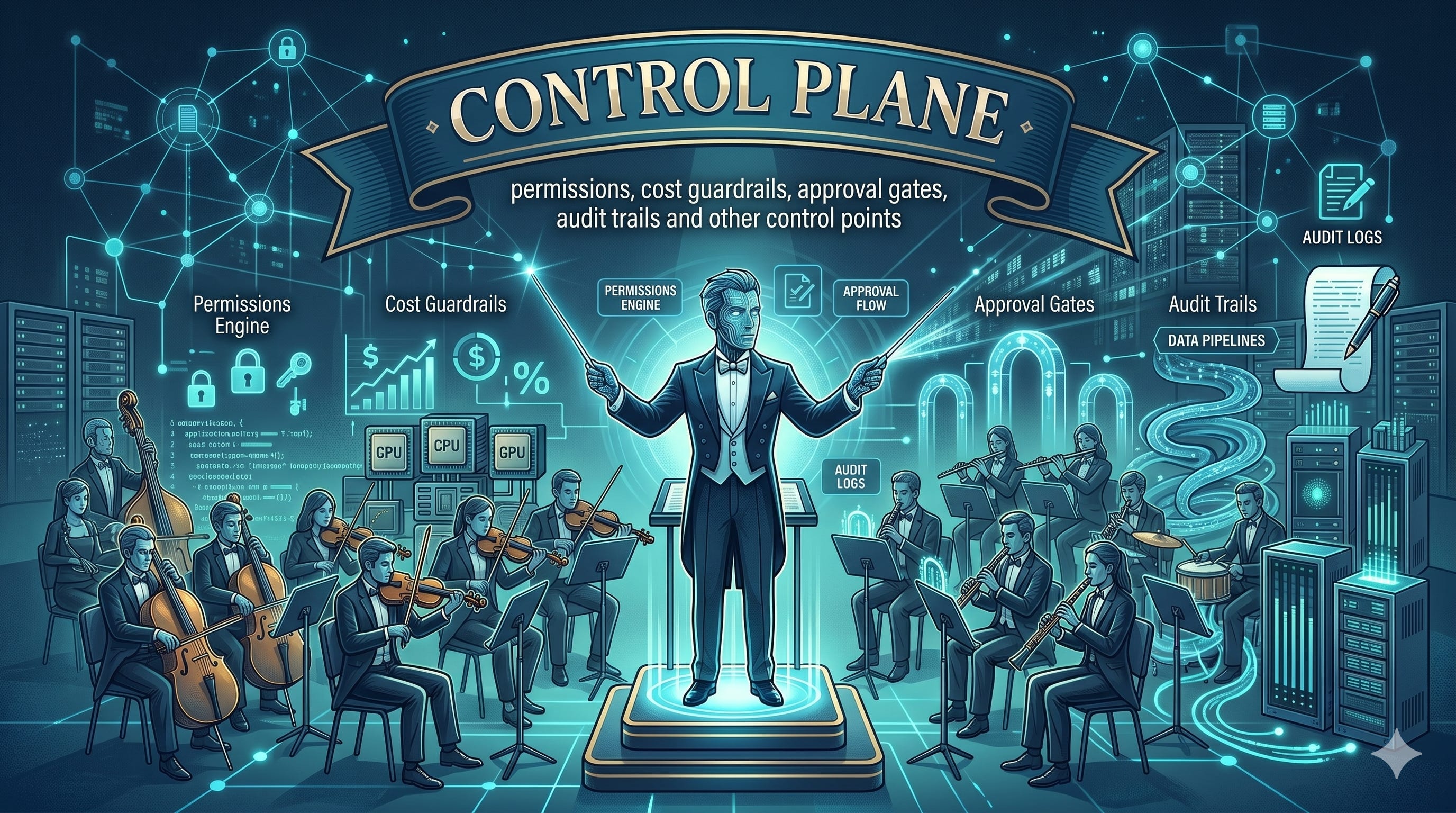
Every team building AI agents right now is repeating the same mistake—and most won’t realize it until it’s expensive.
The proof points are in: a working sandbox, a demo that landed, and leadership, after a beat of hesitation, gave the greenlight to deploy.
Then reality sets in. There are no:
structural permissions, just prompt-level “please don’t delete things”
cost guardrails, so one runaway loop burns $200 - or significantly more - overnight.
approval gates on high-risk actions.
audit trails for when things go wrong. And something always does.
These are trust gaps, not feature gaps. And without trust, agents never touch anything that matters.
The common misread: teams think a control layer means a better system prompt. It doesn’t. A prompt is a suggestion. The model can ignore it, drift from it, or satisfy it in ways you never anticipated. That’s not a control layer. That’s a polite request.
A real control layer makes out-of-scope actions structurally impossible. The execution environment simply never surfaces the tools. Asking nicely has nothing to do with it. The model can’t circumvent access it was never given.
The distinction is sharper than it sounds. Behavioral guardrails work at the persuasion layer: you’re hoping the model stays in bounds. Architectural guardrails work at the execution layer: the bounds are defined by what’s structurally possible, not what’s been requested. One is a policy. The other is a wall. Under production pressure (context window filling, instructions degrading into background noise, a model mid-task with compounding state) a system prompt offers almost no protection. The architecture either blocks the action or it doesn’t. There’s no middle ground.
This is the insight almost nobody is building around: control layers matter more than model quality. The most capable agent you can deploy is a liability without answers to four questions for every action it takes: What did it do? Why? What did it cost? Who approved it?
Any agent can impress in a demo. Only the ones backed by permissions, approvals, budget caps, and audit trails actually make it to production. Not glamorous. Not the work anyone leads with at a conference. But the only work that actually determines whether the system is trustworthy.
Reliability sits upstream of everything else and teams consistently misprice this. Reliability isn’t one property among many. It’s the prerequisite that makes every other property meaningful.
The logic is unforgiving. Access without reliability is a liability: you’ve handed an unstable system real tools and real consequences. Intelligence without reliability is a demo: sharp under controlled conditions, dangerous at the edges. Security without reliability is a false promise: your threat model covers the risks you anticipated, but unreliable systems fail in unscripted ways. And unscripted failures are precisely where breaches live. You cannot secure a failure mode you didn’t predict. Reliability doesn’t sit beside capability, security, and efficiency on a checklist. It’s the condition under which any of those properties hold.
The teams that survive this shakeout won’t have the best models. They’ll have solved the trust problem—and recognized early that the model is the least controllable part of the system, which makes it the least important part to optimize and the most important part to constrain.
Governance isn’t a feature bolted on after the product works. It’s what determines whether the product works at all outside a demo environment.
Twelve months from now, the winners will be running agents on consequential work, at scale, with confidence. The differentiator won’t be what’s under the hood. It’ll be whether the control layer was built first or never built at all.
$200? Pshaw. Try $4000 looking up the same address in Google Maps API 350,000 times.